Skip to content


Table of Contents
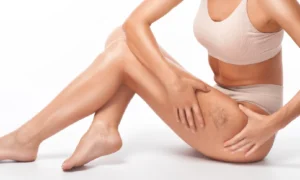
Most people notice them in a dressing room mirror or a summer photo. A thin web of red or purple lines across the back of the calf, the outer thigh, or the side of the nose.
Spider veins are one of the most common cosmetic concerns we see at Ocean State Laser and Aesthetics, and one of the most misunderstood. Searches for how to get rid of spider veins often bring up creams and supplements that never reach the vessel where the problem is. Knowing what these veins are and why they form is what makes the next step clear.
Why do small red or purple veins show up on the legs?
Spider veins are enlarged capillaries near the skin’s surface that appear as thin red, blue, or purple threads. They form when tiny valves inside the vessels weaken and blood pools. Family history, pregnancy, long hours on your feet, and sun damage all raise the risk. Most are cosmetic and fade with laser therapy or an injected solution called sclerotherapy.
What Spider Veins Actually Are
Spider veins are small blood vessels that have widened enough to show through the skin, usually as red, blue, or purple lines in a branching pattern. Clinicians call them telangiectasias, which simply means dilated capillaries sitting close to the surface.
Legs are the most common location, and gravity helps explain why. Blood in the lower body has the farthest to travel back to the heart, so those vessels work under steady pressure all day. On the face, capillaries around the nose and cheeks sit beneath thinner skin, so sun exposure and flushing leave marks there. For facial redness specifically, our work with brown and red spots goes further. For most people, the concern here is purely cosmetic.
How Spider Veins Are Different From Varicose Veins
The difference comes down to size and depth. Spider veins sit at the surface, stay flat, and rarely measure more than a millimeter across. Varicose veins are larger, deeper, often raised enough to feel rope-like, and far more likely to ache, throb, or swell.
Both trace back to the same circulation issue, so plenty of people have some of each. Having one set does not mean the other is coming.
What Causes Spider Veins to Form
Ask what causes spider veins, and the answer starts inside the vessel. Veins move blood toward the heart against gravity, relying on one-way valves to keep it heading that direction. When those valves weaken, blood pools instead of moving upward, and the vessel stretches until it becomes visible.
Several factors influence how quickly that happens:
- Genetics. Family history is the strongest single predictor. If your mother or grandmother had them, your odds go up considerably.
- Hormonal changes. Pregnancy raises blood volume and relaxes vessel walls, so leg veins often appear or worsen during and after it.
- Time spent upright or seated. Nurses, teachers, stylists, and anyone on their feet for long stretches tend to see them earlier, as do people who sit all day.
- Sun exposure. On the face, accumulated UV damage weakens the collagen supporting capillary walls.
- Age. Vein walls lose elasticity over time, so the same daily pressure shows more at fifty than at twenty-five.
Symptoms of Spider Veins and When They Signal Something More
Most people asking about spider veins symptoms are surprised to learn there usually are not any, which is why appearance brings the large majority in. When symptoms do appear, they stay mild: light aching or burning, occasional itching, or a heavy feeling in the legs after a long shift on your feet.
At some point, the picture changes. Persistent leg swelling, skin thickening near the ankle, or leg pain that interferes with daily activity can point to chronic venous insufficiency, a circulation problem in the deeper veins. That calls for a vascular specialist, not a cosmetic treatment. If any of it sounds familiar, reach out to our team before scheduling anything aesthetic.
Treatment Options for Spider Veins
Effective spider veins treatment options work on the vein itself, and we offer two of them.
Laser spider vein treatment directs focused light energy at the vessel. The blood inside absorbs that energy as heat, collapsing the vein wall. The body gradually clears the closed vessel, and the line fades over the following weeks. No incisions or needles are involved, making it a frequent choice for facial capillaries and finer leg veins.
Asclera® Sclerotherapy takes a different route. A sclerosing solution called polidocanol is injected into the vein, irritating the lining so the walls swell and seal together. Over time, the vessel is reabsorbed while blood reroutes through healthier nearby veins. Asclera® is FDA-approved for uncomplicated spider veins and small varicose veins of the lower extremity, which makes it well suited as treatment for spider veins on legs, particularly larger vessels that laser energy reaches less well.
The right approach depends on what a provider assesses in person: vessel size and depth, location, skin type, and medical history.
What Helps Slow New Spider Veins From Forming
Daily habits reduce the pressure that produces new vessels, though they cannot erase the ones already there. Movement matters most. Breaking up long stretches of sitting or standing keeps the calf muscles pumping, which pushes venous blood upward. Elevating your legs in the evening gives those valves a rest, and compression socks work on the same principle. Daily sunscreen protects facial capillaries by preserving the collagen around them.
Where genetics drive the pattern, prevention slows the pace without stopping it.
Clearer Skin Starts With Understanding What You Are Seeing
Spider veins come from weakened valves in small surface vessels, with genetics, hormones, and hours spent upright contributing. Most cause no symptoms, but persistent swelling or changes in ankle skin warrant a vascular opinion first. When appearance is the concern, laser treatment and Asclera® Sclerotherapy are the two spider vein removal treatment options that close the vessel so it fades from view
Spider Veins Treatment in East Greenwich, RI starts with an in-person look, so a useful next step costs nothing. Note where your veins sit, whether your legs feel heavy after a long day, and how long they have been there. Schedule your Spider Vein Treatment consultation today.